
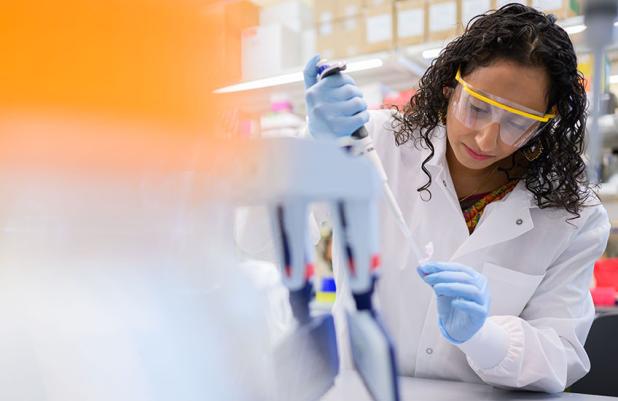
Anusha Nathan. Images: Gretchen Ertl
From machine learning to clinical care, graduating HST MD, and Harvard PhD student Anusha Nathan tackles infectious disease.
Stephanie M. McPherson | Harvard Medical School
Harvard Medical School MD-PhD student Anusha Nathan loves engaging with the humanity of a moment, whether through Indian classical dance, caring for a patient, or making life-saving discoveries.
“I’m a dancer. I’ve loved telling stories on stage. And part of why I came to medical school is because I feel like you’re invited into some of the most intimate moments of an individual’s story,” said Nathan, who completed her PhD in immunology in 2024 and will graduate with her MD in May.
This empathy has driven her for more than a decade, since a particularly energizing sixth-grade biology class on bones and anatomy inspired a desire to create prosthetics for a living. Though she shifted from engineering to medicine as an undergraduate at the California Institute of Technology, her focus on making people better stayed strong.
Nathan first applied to the Harvard-MIT Program in Health Sciences and Technology (HST) MD track to satisfy both her medical interests and her need to understand how things work.
“It was my dream program,” she said.
Part of the attraction of HST was its focus on the mechanistic underpinnings of medicine and understanding why organ systems function the way they do. She said she was also drawn to its “enormous emphasis on doing good research that is going to fundamentally change the field of medicine.”
Nathan’s sights are set on applying her knowledge of computational tools and viral immunology to design vaccines and treatments that improve and save lives, from hepatitis protection to a universal coronavirus vaccine.
A shot in the arm to an interest in research
Nathan started researching HIV vaccines as part of her HST thesis work in February 2020. Less than two months later, her entire path changed.
The day scientists released the genetic sequence of SARS-CoV-2 — the virus behind the mounting death toll of the COVID-19 pandemic — Nathan’s research advisor, Gaurav Gaiha, texted her asking whether she wanted to work on developing a vaccine for it. Energized by the possibility of contributing, Nathan said, “Let’s do it.”
“It was the most whirlwind experience of my entire life to be able to do science at the pace that we did it in an atmosphere full of individuals who just wanted to make a difference,” she recalled.
The excitement of discovery ignited her passion for research and compelled her to pursue a PhD in addition to the MD. She enrolled in the Program in Immunology at the Harvard Kenneth C. Griffin Graduate School of Arts and Sciences and HMS.
With guidance from Gaiha — HMS associate professor of medicine at Massachusetts General Hospital and a core member of the Ragon Institute of Mass General Brigham, MIT, and Harvard — Nathan worked on rationally designing and validating novel vaccines to protect against COVID-19 and related diseases.
Current COVID vaccines create an antibody response that recognizes pieces of a virus and flags them for immune system attack. The vaccines are based on what scientists know about circulating strains of the virus, necessitating yearly boosters as the virus evolves.
Nathan and colleagues in the Gaiha Lab developed vaccines that trigger a different part of the immune system: T cells. T cells directly kill a virus and can recognize aspects of viral particles called epitopes that are unlikely to mutate from year to year or across related viruses, such as SARS-CoV-1, SARS-CoV-2, MERS, and coronaviruses that cause the common cold. The team hopes that the vaccines, which are now in animal trials, will one day supplement existing COVID vaccines and reduce the need for annual boosters.
“Those epitopes that we identified have remained completely conserved from the beginning of the pandemic, despite the massive variation in the virus that we’ve seen in the intervening six years,” she said. “Our goal is to augment the responses from the current vaccines to prevent us from needing boosters every single year.”
Part of the work involved developing a machine-learning tool, MUNIS, to identify useful T-cell epitopes faster and more accurately than existing methods. Among the funders was the Mark and Lisa Schwartz AI/ML Initiative at the Ragon Institute, a consortium of academics, clinicians, and industry representatives that aims to integrate artificial intelligence and translational immunology to address infectious diseases of global importance.
Nathan was invited to present her work to the World Health Organization in February 2022 and the United Nations Science, Technology, and Innovation panel in May 2022.
She also received the 2024 Jeffrey Modell Prize, bestowed by the Jeffrey Modell Foundation and Harvard’s Graduate Committee of Immunology to graduating students in recognition of excellence in their graduate career and dissertation.
Nathan concurrently worked at the Ragon Institute to develop vaccines for HIV that are now in clinical trials in sub-Saharan Africa.
Bringing the lab to the clinic
Nathan’s research has already informed her clinical work. During her internal medicine clerkship at Mass General, she cared for a patient with end-stage liver failure who was experiencing dangerous, unexplained inflammation. Nathan dug through what she had learned about the immune system in the lab to try and find the cause and bring comfort to the patient.
“All these questions built directly off of the science that I had done during my PhD in viral immunology, and I got to directly translate that science into clinical medicine,” she said. “I loved how we can really make a difference in an individual’s life when we merge our interests in science and medicine.”
Although the patient ultimately died from complications of their condition, the moment motivated Nathan to specialize in internal medicine, specifically hepatology. Nathan hopes to combine her knowledge of liver disease and immunology to create vaccines and treatments that would protect people from contracting viral hepatitis and prevent those with the disease from progressing to cirrhosis or cancer.
She’ll pursue this work after graduation in Mass General’s Stanbury Physician-Scientist Pathway, an internal medicine residency for doctors interested in conducting rigorous bench research alongside a clinical practice.
Nathan is grateful for all the doors that her experience at HMS opened for her.
“I think there’s a high likelihood that if I had gone anywhere else, I wouldn’t have done the PhD,” she said. “In addition, HMS has given me the opportunity to represent the school internationally, whether that was in South Africa or Italy or at the WHO or the UN.
“I’ve had all these wonderful opportunities,” she continued, “and I think it’s because of the mentors I met here as well as the science and medicine that I’ve been able to do because of the ecosystem that HMS has fostered.”
Nathan looks forward to a career steeped in moments of connection, in the lab and clinic and beyond, to reach people in the world whom her work could help.
“Being open and honest about the transformation that we want to make in our field is going to be incredibly impactful,” she said. “What that means to me is saying, ‘Look, I’m creating a vaccine that will hopefully protect you forever against not just SARS-CoV-2 and its variants but also other similar viruses like SARS-CoV-1 that caused a pandemic and MERS that caused a global outbreak, such that if this were to happen again, which it hopefully never will, it won’t be a big deal.’”
*Originally published in Harvard Medical School.