
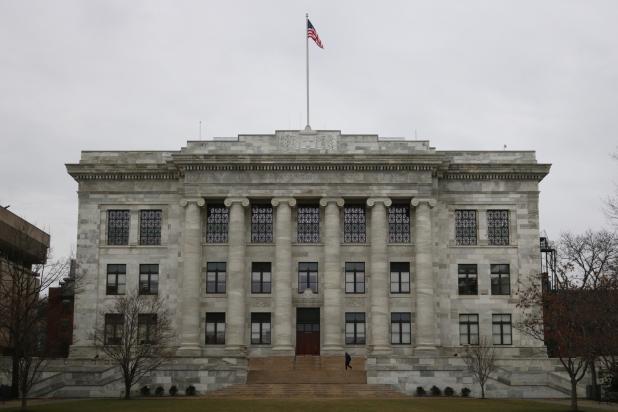
HST students, both current and alum, as well as faculty and staff, gathered for a scientific keynote, and to celebrate the end of a busy school year.
Mindy Blodgett | HST
In a presentation at the HST 2026 Community Awards and Spring Dinner, called “Nature, Nurture and HST”—Andrew Aguirre, HST MD ‘07, PhD, and Aaron Aguirre, HST MD ‘08, HST MEMP PhD ‘08—twin brothers, shared some memories of their time at HST, describing it as a transformative experience that led to their current successful careers as physicians and scientists.
Andrew is a medical oncologist at the Dana-Farber Cancer Institute, an Associate Professor of Medicine at Harvard Medical School (HMS), an Institute Member at the Broad Institute of Harvard and MIT, an Associate Director for the Hale Family Center for Pancreatic Cancer and a Co-Director of the Center for RAS Therapeutics at DFCI. Aaron is a physician-scientist and an attending critical care cardiologist at the Massachusetts General Hospital (MGH) with a research laboratory located at the Wellman Center for Photomedicine and the Center for Systems Biology at MGH and an Assistant Professor of Medicine at HMS.
Speaking first, Andrew spoke of the brothers’ childhood in Michigan—their father was a tool and die maker at a car company, their mother was a nurse—and of how they both graduated from the University of Michigan, both deciding to come to HST.
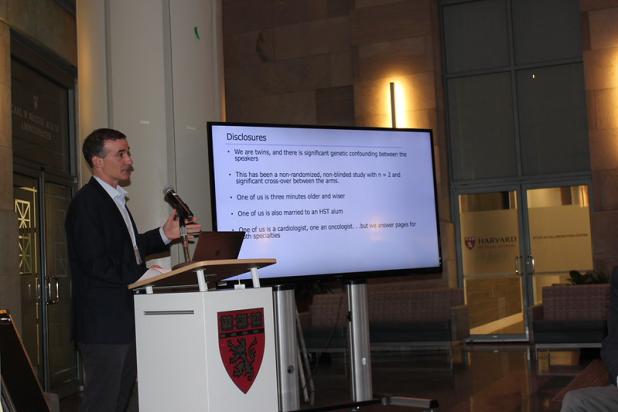
Andrew Aguirre, HST MD '07, PhD speaks at the HST Community Awards and Spring Dinner at Harvard Medical School.
“HST was amazing for us,” he said. “We were inspired by so many brilliant people…we couldn’t have asked for better training.”
Andrew described how his PhD project—a mouse model of pancreatic cancer—was the basis of his current focus on gastrointestinal and pancreatic cancers, at the Aguirre Lab at Dana-Farber. He said that the treatments for pancreatic cancer have progressed from a terminal illness to one where there is a “promising therapeutic landscape.” The Aguirre Lab uses approaches like genomics to understand RAS-driven cancers, and to run clinical trials in search of new treatment strategies.
Aaron, who says he came to HST as an electrical engineer—enrolling in the Medical Engineering and Medical Physics (MEMP) program—found a path to becoming an MD through his scientific pursuits, as well. While HST MEMP students are interested in getting clinical experience to inform their scientific pursuits, sometimes the experience of being a MEMP can be a “side door” to deciding to pursue an MD, he said.
Aaron told the attendees to “pick hard problems, think big, and have a vision” as they work toward their degrees and proceed in their careers.
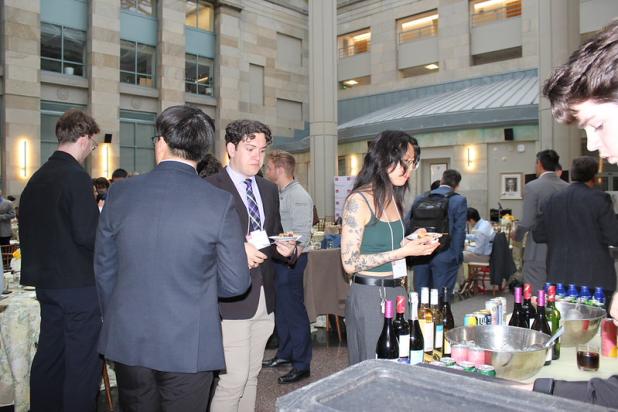
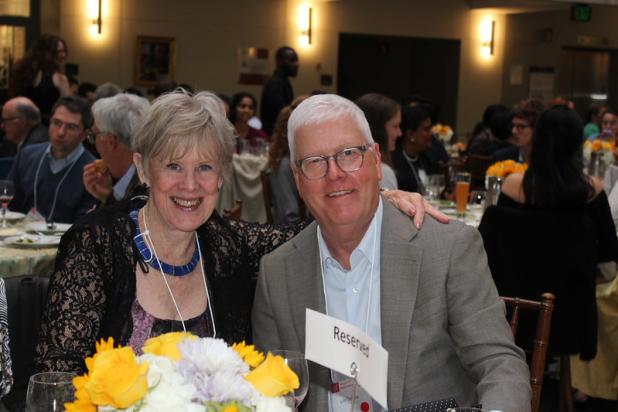
The annual traditions of the HST Community Awards and Spring Dinner, including the scientific keynote, took place April 30 at the Harvard Medical School’s Tosteson Medical Education Center’s (TMEC) Atrium in Boston. There were about 170 attendees, including students, faculty, and staff—who gathered to honor the award recipients, and to hear the Aguirre brothers speak.
The HST Dinner Seminar series was launched in 1974 with a generous grant from the Kieckhefer Foundation. Past speakers have included Ai-Ris Yonekura Collier, Assistant Professor in Obstetrics, Gynecology, and Reproductive Biology at Harvard Medical School (HMS); Francois Jacob, winner of the Nobel Prize in Medicine and Physiology; Mary Ellen Avery, Thomas Rotch Morgan Professor of Pediatrics; Edward K. Rodriguez, chief of orthopedics at Beth Israel Deaconess Medical Center (BIDMC), and Susan Hockfield, professor of neuroscience and President Emerita of MIT.
The 2025 HST Awards Committee—including the following HST students: Jules Allbritton-King, Angel Odukoya, Maxina Sheft, Ginger Schmidt, Erick Rocher, and Jasleen Gill —organized the awards nomination process, and was chaired by Albritton-King. Collin M. Stultz, MD PhD, Nina T. and Robert H. Rubin Professor, Electrical Engineering & Computer Science; Co-director, HST, and Associate Director, MIT Institute for Medical Engineering and Science (IMES), was the emcee for the awards part of the evening. IMES is HST’s home at MIT.
Here are the awards, the recipients and presenters:
- Irving M. London Teaching—Faculty: Dr. Stuart Forman, MD, PhD
Presenters: Claire Brown, Clare Sparling
Awarded annually to recognize teaching faculty who have made exemplary contributions to the teaching of HST students.
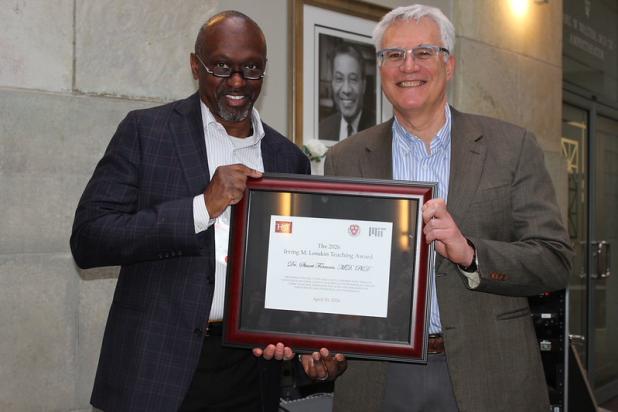
Collin M. Stultz, MD, PhD left, Dr. Stuart Forman, MD, PhD, recipient of Irving M. London teaching award, right.
- Seidman Prize for MD Research Mentorship: Dr. George S.M. Dyer, MD (not present)
Established in 1999, this award is presented annually to the person who, through the warmth of their personality, inspires and nurtures HST students in their scientific and personal growth, and through honest advice and generosity to all students and colleagues sets an admirable example of excellence and mentoring.
- Thomas A. McMahon Mentoring Award: Dr. Brett Bouma, PhD
Presenters: Georgia Jones, Ginger Schmidt, Lia Gomez-Perez, Maxina Sheft
Given annually to recognize teaching faculty who have made exemplary contribution to the teaching of HST students.
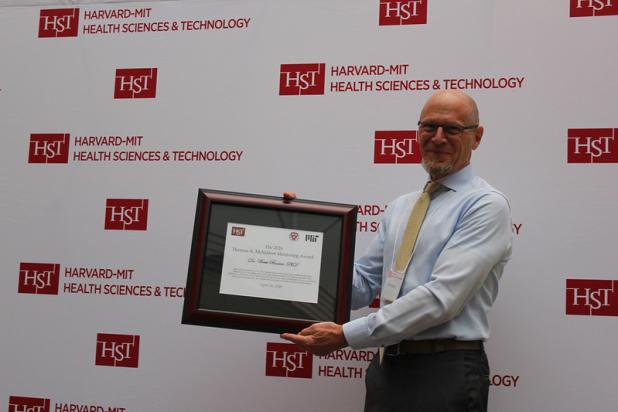
Brett Bouma, PhD, recipient of Thomas A. McMahon Mentoring Award
- Roger G. Mark Outstanding Service Award (Student): Aashini Shah and Cassandra Parent
Presenters: Marissa Morales and Alana Mermin-Bunnell
Presented annually to a member of the student body whose excellence in action and deed embodies HST community values and ideals.
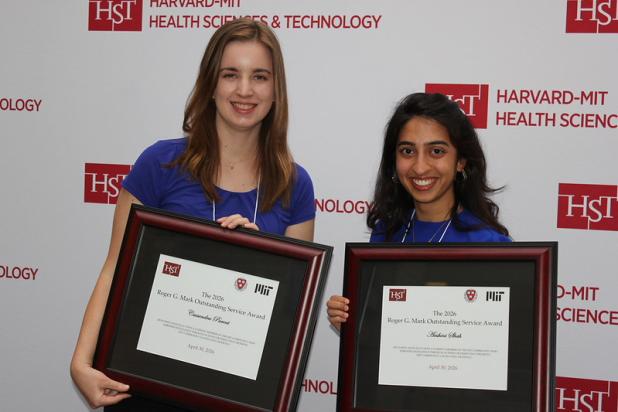
Cassandra Parent, left, and Aashini Shah, recipients of Roger G. Mark Outstanding Service Award (Student)
- Roger G. Mark Outstanding Service Award (Faculty/Staff): Katrina Norman
Presenter: Ed Banigan
Presented annually to a staff or faculty member whose excellence in action and deed embodies HST community values and ideals.
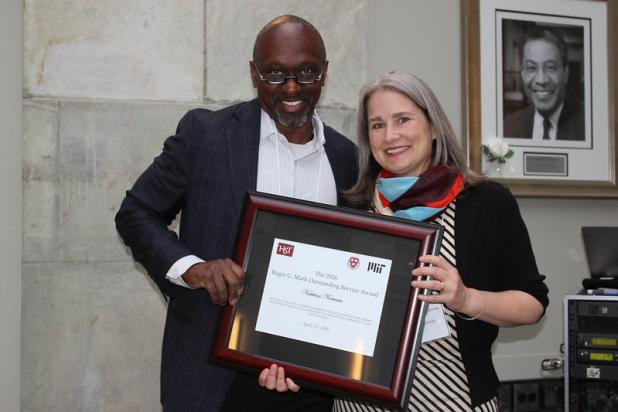
Collin M. Stultz, MD, PhD, left; Katrina Norman, recipient of the Roger G. Mark Outstanding Service Ward (Staff), right.
- HST Outstanding Teaching Award – Student: Lauren (Mickey) Sloat
Presenter: Cathy Hua
Given annually to a current HST student who has made noteworthy contributions to one or more classes in the HST curriculum through remarkable efforts as a teaching assistant.
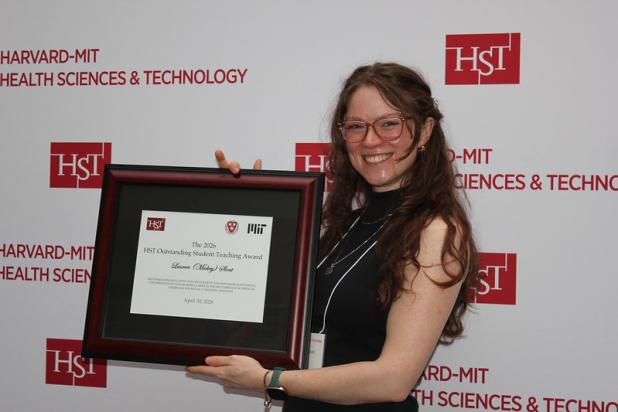
Lauren (Mickey) Sloat, recipient of HST Outstanding Teaching Award—Student
Stultz also honored Lee Gehrke, Hermann L.F. von Helmholtz Professor, Institute for Medical Engineering & Science, Massachusetts Institute of Technology Professor, Microbiology and Immunobiology and Health Science & Technology, Harvard Medical School, who is retiring.
Lee Gehrke, right
More information about the HST student awards can be found here.