
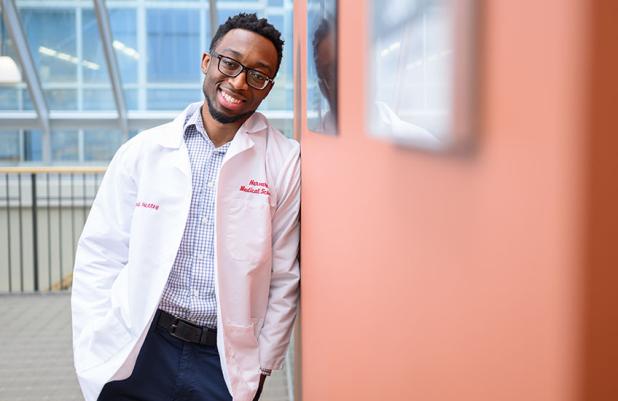
Leonard Nettey. Image: Gretchen Ertl
For graduating HST student Leonard Nettey, there are many ways to make a difference.
Christina Hernandez Sherwood | Harvard Medical School
Leonard Nettey almost missed out on one of the most meaningful opportunities of his life.
Nettey was early in his MD-PhD training in immunology in the Harvard-MIT Program in Health Sciences and Technology (HST) when classmate Ashley Kyalwazi asked him to help lead a national nonprofit that would empower more Black students to pursue careers in health care and biomedical science.
Already serving as executive director of Harvard Medical School’s Health Professions Recruitment and Exposure Program, a science enrichment program for local high school students, Nettey turned her down.
“I was worried about stretching myself too thin,” he said, “and about not being able to give the idea the attention it needed.”
Kyalwazi’s goal was indeed ambitious. While Black Americans make up 12 percent of the U.S. population, they account for only 6 percent of the physician workforce. The reasons why are complex and rooted in longstanding systemic inequalities. Yet Nettey knew that evidence showed Black patients benefited when treated by Black doctors. And he wanted to be part of the solution.
So when Kyalwazi asked again, less than a year later, Nettey accepted. By then, he had settled into his medical studies at HMS and his doctoral research in pediatric inflammatory bowel disease (IBD) in the laboratory of Alex Shalek, an HST faculty member based at MIT.
“Whatever you’re doing at HMS, they inspire you to be a ‘physician plus,’” Nettey said. “For me, I thought that was physician-scientist — and it was, but when [the nonprofit] got more prominent in my life, I had great support here, including from Alex.”
Nettey and Kyalwazi’s hard work paid off. In 2023, their nonprofit, called the MV3 Foundation — which stands for “Mobilizing Voices Through Education, Service, and Advocacy” — won the Harvard Business School New Venture Competition, and its first cohort of scholars completed the program. Today, MV3 has helped over 175 undergraduates nationwide by giving them a community of peers and free academic and professional mentorship.
Nettey said he hopes MV3 will launch the careers of more Black medical professionals and, in a domino effect, create more mentors for future generations.
“When I reflect on my journey,” he said, “I’m here because I’ve had so many valuable mentors in my life.”
With his PhD complete and his MD degree to be conferred on May 28, Nettey is set to continue building his career as a physician-scientist and providing the support for young people that others have invested in him. The next step: a residency in internal medicine at Brigham and Women’s Hospital.
“I don’t see a future for myself that doesn’t incorporate being with patients, contributing to research and the advancement of academic medicine, and supporting the next generation,” he said.
Rooted in community and research
Nettey was born in Canada to Ghanaian immigrants. Throughout his childhood, first in a Toronto suburb and then outside Atlanta, Nettey’s family was surrounded by a close-knit, supportive community.
“We always had people who helped us get started and get to the next step,” he said. “I credit this community upbringing with the idea that it’s good to look after people.”
School came easily to Nettey — until he enrolled in a demanding molecular life sciences program as an undergraduate at the University of Pennsylvania.
“I had a huge gap,” he said. “The other students clearly knew so much more.”
He developed new study strategies to catch up.
But he said the most important lesson from that difficult first year wasn’t an academic one; it was learning to separate his sense of self-worth from his academic performance.
“I focused on being a good person and giving back to the people around me,” he said. “Then, no matter how poorly any test goes, I always have my friends, my family. It’s like you’re stacking the deck because you’ve already won.”
After graduation, Nettey spent two years working on vaccine research at the National Institutes of Health and deepening his growing interest in immunology. He was, and still is, drawn to the way individual immune cells work together on a common mission.
“You have all these cells with the same overall purpose,” he said. “But each individual one, especially T cells and B cells, have their own flavor.”
When it came time to choose a medical school, Nettey was intrigued by the HST curriculum, which is geared toward medical students interested in research. He also knew there would be no better place to pursue his PhD in immunology.
“There were just so many labs to choose from,” Nettey said. “I didn’t know exactly what I wanted to do, but I knew I was going to find something that would fit based on the breadth of amazing lab experiences.”
Advancing care for pediatric inflammatory bowel disease
Nettey joined Shalek’s lab, jumping into a research project on T cells in pediatric IBD. IBD is a group of autoimmune diseases that cause severe gastrointestinal symptoms and require lifelong management. Finding the right treatment can be a frustratingly slow process.
The project aimed to take some of the guesswork out of matching patients with treatments. Lab members examined the molecular profiles of newly diagnosed pediatric patients with IBD to try to predict whether they would respond to a particular treatment. The study found that features of certain T cells were associated with a lack of response to that treatment — an important finding that indicated patients with those T-cell features would fare better with a different therapy.
For his part, Nettey handled the primary data analysis and project management of the multicenter study. He is co-first author on the resulting paper, which is currently in preprint. The experience hit a sweet spot for him: intellectually stimulating research that had the potential to directly help patients in the near future.
Nettey’s work earned him the 2024 Jeffrey Modell Prize, bestowed by the Jeffrey Modell Foundation and Harvard’s Graduate Committee of Immunology to graduating students in recognition of excellence in their graduate career and dissertation.
The importance of the research hit home when, after completing his PhD in 2024, Nettey met an adult patient during an HMS clinical rotation who had IBD and had failed treatment.
“Even with all the knowledge I had amassed through my PhD — how IBD works, the immunology of it, the drugs for it — we still didn’t have an answer for this individual in front of me,” he said. “It’s very humbling.”
Originally published in Harvard Medical School news.