
Zuriel Erikson Valencia Joven, HST MEMP PhD, focuses on optical methods for in vivo elastography, with potential clinical targets spanning degenerative eye diseases, sickle cell disease, and cancer.
Mindy Blodgett | IMES/HST
Zuriel Erikson Valencia Joven is an HST Medical Engineering Medical Physics (MEMP) PhD student, who grew up in Sacramento, California and who earned his BS and MSE in mechanical engineering from Johns Hopkins University. Read on to learn more about Zuriel's research, his background, and his plans for the future.
Why did you choose the HST program?
I applied to PhD programs in both biomedical and mechanical engineering, but I chose HST for the unique opportunity to experience medical didactics and clinical immersion without compromising rigor in my continued graduate education in mechanical engineering. Being in the field of biophotonics, I was also drawn to the rich history of biomedical optics and photonics in the Boston area (i.e., MIT’s LBRC and RLE, MGH’s Wellman Center for Photomedicine) and the plethora of seminal researchers available as mentors. Plus, the community I met at the visit weekend was equally as impressive as it was welcoming, making HST too hard to say no to.
Can you tell us about your research interests, and what you hope to accomplish?
Over the years, I have been very broadly interested in advancing noninvasive and minimally invasive diagnostics and interventions, spanning the fields of biomedical optics and biophotonics, surgical robotics, and prosthetic control. Any application that can increase access to healthcare technology via decreased invasiveness, lower operator burden, or improved cost-efficiency is intriguing to me.
Recently, I have begun to more explicitly work on the intersection of biophotonics and biomechanics in exploring optical methods for elastography, as evidence of the role of viscoelasticity in biological and pathological processes grows exponentially. I just completed my first year here, so the clinical target for my contributions (whether that be ophthalmology, hematology, intraoperative imaging, etc.) remains an open question.
You are a part of the Yun Lab at the Wellman Center for Photomedicine, at MGH. Can you tell us more about this lab, and why you chose it?
Clearly, I find myself interested in many topics without wanting to compromise depth in any of them. I feel that the Yun Lab is the perfect embodiment of this mentality. The Yun Lab has pioneered and led various photon-based technologies for human health, from cell lasers, to the world’s smallest laser, to in vivo Brillouin microscopy. The lab is constantly pushing the boundaries of technological capabilities, while capitalizing on the ability to run device trials with healthy and patient volunteers.
This lab was a no-brainer match for me for several reasons. First, my previous experience with biophotonics was using pre-built systems, so most of my contributions came from the data analysis and photon transport simulation side. However, I wanted to gain hands-on experience in designing and assembling optical setups, a skill that I have been grateful to learn in the Yun Lab.
Second, Brillouin spectroscopy and optical coherence elastography are two nondestructive methods we use to measure the viscoelasticity of tissue in vivo. As a mechanical engineer, the intersection of photonics, mechanics of materials, and biomechanics simultaneously satisfies multiple areas of my intellectual curiosity. Additionally, having the opportunity to work on in vivo sensing and translate the work directly to human trials in the hospital lab is extremely rewarding.
Finally, Andy (Seok-Hyun "Andy" Yun, PhD, is the director of the Yun Lab) is such a strong role model as a scientist, mentor, and human being; the rest of the lab constantly vocalizes the same sentiment. The coexistent breadth and depth of the lab is uniquely enabled by Andy’s never-ending dedication to learning and rigor. He is more than willing to work through a messy dataset with us, while also prioritizing our well-being as people. It’s extra encouraging to be surrounded by people who also want to be like Andy in the next phases of our careers.
Do you have any hobbies you’d like to tell us about? What do you like to do in your spare time?
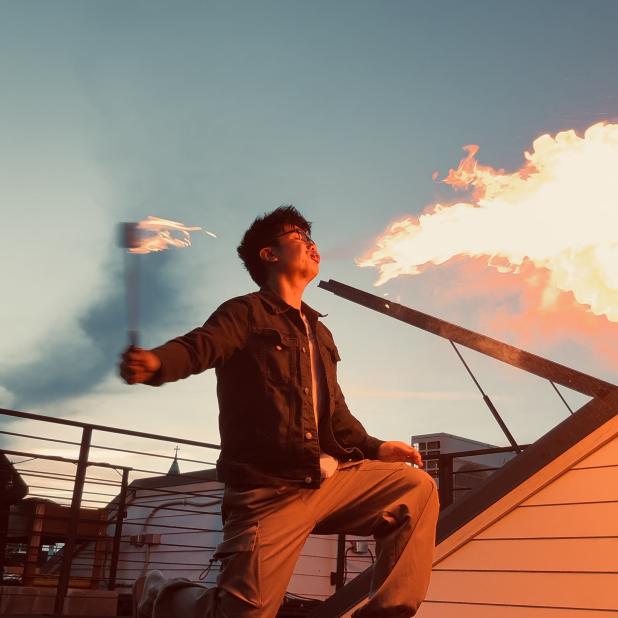
Just like my research interests, I have a very scattered assortment of hobbies. I love firebreathing and firespinning, breaking, tennis, speedrunning Minecraft, and small hobby projects. I also used to develop video games and perform tinikling, the national folk dance of the Philippines. Every now and then I’ll try something new and add whatever sticks to the list!
What are some small things that make your day better?
Pretty sunsets :)
What do you hope to be doing in 10 years?
In 10 years, I’d want to be back home in NorCal, ideally working in some part of the Bay Area. Specifically, the top 3 dreams would be running a MechE lab focused on the use of photonics and robotics in biomechanics and medicine, working on intraoperative or endoscopic imaging at Intuitive, or developing optical health sensing hardware at Apple.