
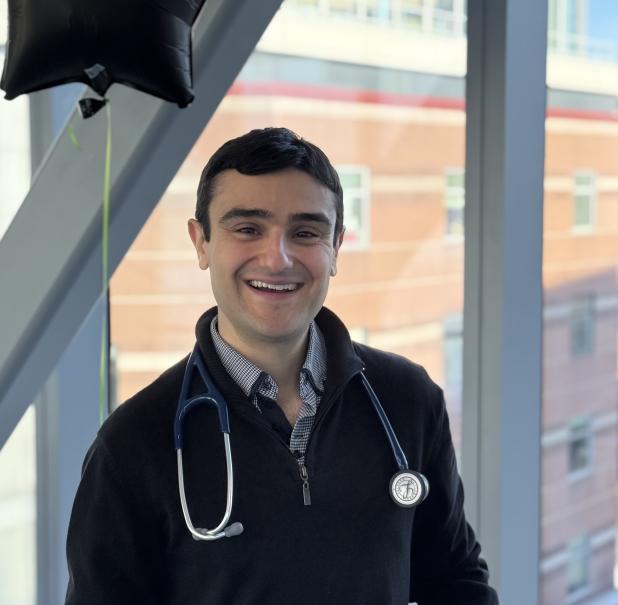
Berger says that research becomes more rewarding when you can ask, and answer, your own scientific questions.
Mindy Blodgett | HST
Growing up in suburban Maryland, Adam Berger, HST MD ’26, HST PhD ’24, says his interest in math and science surfaced at an early age, and that supportive teachers and mentors encouraged him, showing him that “being a nerd is awesome.”
In high school, he volunteered at the local hospital, an experience that awakened an interest in helping others. “I realized that it was so special to be in someone’s life in that caring role,” he says. “And that it was also a great way to apply scientific knowledge.”
It’s not surprising, then, that Berger eventually found his way to medicine, science, and engineering—and to the Harvard-MIT program in Health Sciences and Technology (HST). Berger—whose research has focused on engineering drug delivery systems—applied to HST at the advice of a mentor at the University of Maryland, College Park. This summer, Berger, who was the student speaker at the HST 2026 graduation on May 26, starts an internship and residency in Pediatrics at Boston Children’s Hospital and Boston Medical Center.
He studied bioengineering at the University of Maryland, where his interest in scientific research blossomed, though he recalls that at first, it wasn’t easy. “I didn’t enjoy my first summer of research,” Berger says. “In looking back, I didn’t understand, or have enough knowledge…I came back, and did it again, and then it started to become really fun.”
Other formative experiences in college included doing research at the Naval Medical Research Center, in a lab run by Dr. Ian White. “I learned that research becomes more rewarding when you can ask and answer your own questions,” Berger says. He also served in the University senate, a role that “pushed me out of my science-minded bubble.”
When it came time to consider graduate school, the idea of getting a dual MD/PhD wasn’t an option he knew existed. But watching a student a few years ahead of him go down this path, he realized being a physician-scientist could allow him to synergize his interests in caring for the patient in front of him, while also pushing the boundary of what can be accomplished for future patients. Berger’s optics professor, Giuliano Scarcelli, professor, Fischell Department of Bioengineering, was familiar with HST, and had worked with HST graduates, so he encouraged him to apply. “I didn’t know much about HST when I applied, but as I started to investigate more about various programs, I began to see that HST was really unique,” Berger says. “During my undergrad, I liked using MATLAB to model the human body, being able to learn in a mechanistic way. The more I read, the more I could see that HST seemed like a good fit, with the overlapping of medicine and engineering.”
When Berger came to campus for interviews, he says that he worried about the culture shock of these esteemed institutions, “but meeting my future classmates was fantastic. I thought, wow, these people are incredible, and I want to learn beside them!”
During his HST career, Berger has been working in the lab of Paula Hammond, Dean of the MIT School of Engineering. At the Hammond Group at the Koch Institute for Integrative Cancer Research, MIT, he focused on research around delivering genetic therapies that can directly affect the expression of proteins and other RNAs in the cell, with the goal of providing new translational approaches for those with impaired wound healing.
His honors and awards include the MIT IMES Termeer Fellowship of Medical Engineering and Science, the NIH National Research Services Awards for Individual Predoctoral Fellows, the HST Roger G. Mark Outstanding Service Award, the HMS Gerald Foster prize, and he was a Hertz Foundation Fellowship Finalist.
In looking back at his time at HST, he says that “I really had to relearn learning,” to succeed. He says that the challenge of getting both an MD and a PhD, “is that the way that you learn medicine is so different from how you learn to be an engineer.”
“With engineering, if I learned the core principles, say, to understand physics, I could derive from the basics and get pretty far,” he says. “Coming to the MD, I thought it was a laundry list of factoids, and I was used to learning in a big picture way. You can’t learn everything, but what if you ignore something that is the one thing that I need for my patient? So, I had to take it back to fundamentals.”
“I had mentors and faculty advisors, who all really helped me, and after every single lecture I would write down three key things,” he says. “And that gave me a filing system where I could put in some of these smaller details. The more comfortable I have gotten with clinical medicine, though, the more I have realized that diagnosis and treatment of patients is essentially an iterative critical thinking foray, like engineering.”
He says he has fond memories of going away on a retreat with other students to New Hampshire, and of grabbing time for various social events with his classmates, many of whom have become close friends—including some who have been there for important life events. He says that the experience of learning at HST, sometimes had the feel “of being a kid in a candy shop—you get incredible resources…being able to leverage those resources, and to find the community in both Harvard and MIT. It opened a lot of doors…I spent a lot of my time on my bike moving between the two campuses!”
Berger advises anyone considering coming to HST, to be aware that “the benefits of HST is that you really learn from the ground up, you really learn how the body works…you can understand the big picture for how what you are doing will help the patient.”
“You are learning alongside incredible people who are the best support, and mentors and teachers who all want to see our success,” Berger says. “And the curriculum keeps evolving…Now the MD students are learning about AI, big data, and how to think about new ethical challenges in medicine. HST tries to stay at the forefront of all of that.”