
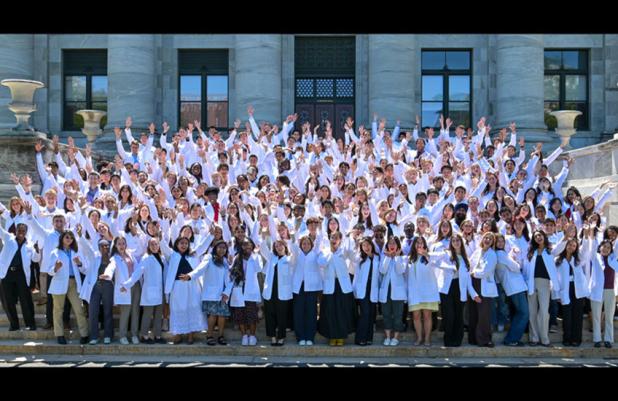
Introducing the HMS and HSDM Class of 2030!
Images: Gretchen Ertl, Steve Gilbert, Steve Lipofsky, and Julia Zoghina
Students embark on challenging and rewarding training
Bobbie Collins | Harvard Medical School
During the first week of August, the Harvard Medical School and Harvard School of Dental Medicine campuses were awash in white and abuzz with conversation when entering medical and dental students gathered as a class and wore their white coats for the first time.
Three days of orientation included the 2026 White Coat Ceremony, an annual ritual at many medical and health professional schools in which the doctor’s white coat is ceremonially bestowed upon entering students at the start of their first year.
A deans’ welcome, patient clinic, visits to communities near HMS, social mixers, and more rounded out the orientation events for the Class of 2030. Classes began on Aug. 6 with the Introduction to the Profession course, during which faculty familiarized students with concepts such as collaborative care, health equity, cultural and structural humility, and privacy and digital professionalism.
But the first step was finding the right fit for their white coats.
The act of donning the white coat signifies the commitment physicians- and dentists-in-training make to provide care with humility and respect to the patients they will have the privilege of meeting while in school.
“The White Coat Ceremony is really important to me. It’s the kind of thing that you dream of since you’re a little kid, and it’s what you think being a doctor or a dentist means,” said DMD student Trunee Hsu. “I’m very proud to be a part of this and hope that I can make the community proud of me.”
The ceremony also provides an opportunity for students to get to know the classmates they’ll be training with over the next four or more years.
Of the entering MD students, 135 will participate in the Pathways program and 30 will pursue their degrees through the Harvard-MIT Health Sciences and Technology (HST) program.
The MD students range in age from 20 to 32 and graduated from 62 colleges, universities, and military academies. The majority, 74 percent, have undergraduate degrees in biology, chemistry, math, or engineering; 19 percent were double majors; 4 percent majored in the social sciences; and 3 percent majored in humanities fields. Eight are entering with doctoral degrees and 24 have master’s degrees.
The 36 entering dental students range in age from 20 to 27 and attended 30 colleges and universities. Thirty-three have undergraduate degrees in biology, chemistry, math, or engineering, and three have degrees in social science fields.
The start of medical and dental school is the result of many years of dedication and hard work. At the ceremonies, students introduced themselves to their classmates and expressed gratitude to the family, teachers, friends, and mentors who supported them in achieving their goal of being a student at HMS or HSDM.
“I had so much support from so many people,” said HST MD student Alexander Tang. “I hope to pay it forward to patients who need help and are coming from diverse circumstances and backgrounds.”
Twenty-one students in the entering class are members of the Harvard/MIT MD-PhD program; 12 are in HST and nine are in Pathways. In addition, one dental student will pursue a DMD-PhD.
The dual degree training prepares them for careers as physician-scientists, in which the synergy between scientific research and clinical care leads to improvements in diagnosis, treatment, and prevention.
“I want to see a patient that maybe has a problem that hasn’t been solved yet, or some acute issue that they’re dealing with, and based on the relationship that I have built with them, turn to the lab and pursue research that’s able to help them directly,” said Melissa Jones, who is taking a physician-scientist approach to her MD training in HST.
Students see patients at HMS-affiliated hospitals and participate in leading research with Harvard and MIT faculty in areas such as bioengineering; the social sciences; and basic, clinical, and translational science.
“I truly believe health can be studied and researched on a variety of levels, from the molecular to the individual patient all the way up to neighborhoods and populations and entire societies,” said Queen Balina, a Pathways MD-PhD student who plans to pursue her doctoral degree in epidemiology.
Deans and advisors warmly welcomed the class on Monday morning. Students heard about the academic, clinical, and career advising, as well as the well-being support, available to them as they encounter the demands involved in becoming Harvard-trained clinicians.
“I’m a little bit nervous, but I’m really excited to be surrounded by such incredible people who are also thoughtful, smart, and compassionate,” said Pathways MD student Jane Santamore, who comes to HMS from Colorado Springs, Colorado, where she was a cadet in the U.S. Air Force Academy. “I think it’s going to be an amazing four years.”
Throughout their training at HMS and HSDM, the students will define their own unique career paths by following their curiosity and passion.
With more than 12,000 faculty members in HMS classrooms, laboratories, and clinics; hundreds of staff with expertise in medical education; and access to a bounty of resources at Harvard, each student is sure to find guidance and mentorship in their interest areas.
During their first encounter with patients, students engaged in active listening — a key skill for clinicians. Patients described to the group their medical histories, their partners talked about helping their loved ones navigate the medical system, and faculty physicians shared their experiences diagnosing and caring for the patients.
“I was so inspired seeing a physician interact with their patients in such a personal way,” said DMD student Zach Neuman. “I knew that as a physician you have to have a close relationship, but if this were a different setting, I would have assumed they were personal friends.”
“Medicine is all about the people. It’s not just about providing the best treatment for a patient,” said MD Pathways student Youssef Ibrahim. “It’s about the empathetic human connection that you create and getting patients from where they’re at to the optimal place that they want to be.”
The students will meet many more patients in their years at school. At the end of orientation week, they will write and pledge an oath to attend to these patients with compassion.
Medical and dental school staff provide robust programs and resources to support students’ personal growth and professional identity formation.
Each student is assigned to one of five academic societies. These communities serve as their home base for mentorship from faculty and more senior students, academic advising, administrative support, study groups, and social connection.
Additionally, staff help students feel that they fully belong to and are engaged with the HMS, HSDM, and wider Harvard and Boston communities, including assisting with disabilities (including nonapparent disabilities), promoting health and well-being, and ensuring a safe environment.
“I want to provide good support to them so they can focus on why they came here — to learn how to be excellent health care practitioners,” said briana Sevigny, director of the medical school learning environment at HMS, a new role focused on promoting accountability, handling medical student mistreatment concerns, and enhancing the overall student experience.
The learning that lies ahead for students includes mastering medical science, including anatomy, genetics, and pharmacology; the structure, function, and normal and abnormal processes of organ systems; and the social and population sciences that influence human health, such as health care policy, social medicine, and medical ethics.
Students will use the latest biomedical technologies and tools, including AI; make new scientific discoveries and develop new therapies; and work collaboratively to provide the highest level of care possible to their patients.
With the knowledge they acquire, students will carry an innovative spirit and humanistic ethos into their own practice.
*Originally published in Harvard Medical School News.